
 Are you ready to embark on a musical journey by having some fun with a few easy piano chords? There’s no better place to start, so let’s do that. Here we’ll walk you through the fundamentals of playing the I, IV, and V chords in the key of C major, setting a solid foundation for your musical exploration.
A Look at the C Major Scale
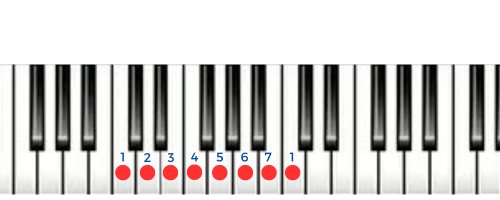
Before we delve into the world of chords, let’s take a moment to familiarize ourselves with the C major scale. The C major scale consists of seven notes, numbered from 1 to 7. These notes are C, D, E, F, G, A, and B. Understanding this scale is crucial as it forms the basis for constructing chords:
The Fingers for these Chords:
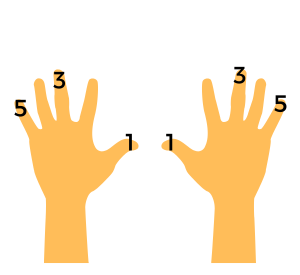
We’ll be using the pinkie, middle finger, and thumb of each hand to play these easy piano chords. Generally, they are referred to as the 1, 3, and 5 fingers:
Our First Chord: The I Chord (C Major)
Let’s start our journey into playing some easy piano chords with the I chord in the key of C major. Place your left hand comfortably on the piano keyboard, ensuring that your pinkie rests on the note C (the 1 of the scale). With this hand position, play every other white key, including E and G. Congratulations! You’ve just played the C major chord, also known as the I chord in the key of C major.
You may be asking: “Which C on the piano keyboard do I start on?” The answer that any C would be correct. However, using the C below the middle C of the piano keyboard is a good choice for the right hand to later be playing a melody. Middle C is the fourth C from the left on a full-size piano keyboard. On a smaller keyboard, it’s the closest C to the middle:


Next: The IV Chord (F Major)
Now that you’ve mastered the C major chord, let’s explore the IV chord in the key of C major. While maintaining the same hand position as before, slide your hand to the right until your pinkie is positioned above the note F (the 4 of the scale). Once again, play every other white key, including A and C. Voila! You’ve now played the F major chord, also known as the IV chord in the key of C major:
F Major Chord

And Finally: The V Chord (G Major)
Our journey wouldn’t be complete without exploring the V chord in the key of C major. With your hand still in the same comfortable position, slide it slightly to the right until your pinkie is positioned above the note G (the 5 of the scale). Play every other white key, including B and D. You’ve just played the G major chord, also known as the V chord in the key of C major:
G Major Chord

Roman Numerals in Music
You may be wondering why we refer to these chords as the I, IV, and V chords. The reason lies in the use of Roman numerals in music theory to denote the degrees of the scale. By using Roman numerals, we can easily identify and communicate chord progressions regardless of the key.
Unlocking Your Musical Creativity
Now that you’ve familiarized yourself with the I, IV, and V chords in the key of C major, it’s time to unleash your creativity. While playing these chords with your left hand, experiment with your right hand by mirroring the chords in a higher range of the piano keyboard. Of course, you’ll be using your thumb for the lowest note of the chord and pinkie for the highest:
C Major Chord

F Major Chord

G Major Chord
Click here for a video lesson that will help you with this
Expand Your Skills with Rapid Piano Mastery
Are you eager to take your piano skills to the next level? Look no further than Rapid Piano Mastery, a groundbreaking online course designed to elevate your playing abilities. Sign up in advance to receive exclusive access when the course launches. Be among the first 500 subscribers to unlock something truly special. Learn more here.
Embrace the Power of Easy Piano Chords
In conclusion, mastering easy piano chords is the first step towards having a lot of fun at that piano or keyboard of yours. By understanding the fundamentals of chords, you lay a solid foundation for your musical journey. So, embrace the magic of I, IV, and V chords, and let the music guide you towards endless possibilities.
With a little bit of practice, along with an open mind to learning, you’ll soon discover the joy of creating beautiful melodies and harmonies. Start your musical adventure today by letting these essential easy piano chords serve as your starting point. Happy playing!
PS
Since you have an interest in having fun with chord on the piano, I have a special online program especially for you. It’s just you and me, one-on-one via Zoom, as you continue your journey with Chord Confidence… I hope you’ll join me!
 Embark on a musical journey like no other with Rapid Piano Mastery, meticulously crafted to guide piano beginners on a transformative quest to unlock the enchanting world of piano playing. Unlike traditional piano courses, this revolutionary program offers a distinctly unique approach, placing practicality, enjoyment, and creativity at the forefront of your learning experience from the very beginning.
 Are you ready to embark on a musical adventure like no other? Say goodbye to the traditional methods of learning piano and welcome the convenience and excitement of online lessons! With Dave’s Zoom piano lessons, you can unlock your musical potential from the comfort of your own home.
 Are you ready to embark on a musical journey that unveils the joy of playing chords and enhances your understanding of musical harmony? Look no further! Today, I’m excited to introduce you to my “Chord Confidence” program conducted live via Zoom.
 I’m passionate about the blues—listening to it, playing it, and teaching it. If you share that love for the blues and want to jump right into playing without getting bogged down by theory, this special blues piano session is designed just for you.
 Ever dreamt of effortlessly creating music on your piano without the tedious task of decoding sheet music? Let’s skip the formalities and dive straight into the exciting realm of piano chords. Here you’ll find a shortcut for beginners to kickstart your musical adventure and experience the sheer thrill of playing right away.
 Ever felt the urge to put the sheet music aside, trading structured melodies for the freedom to experiment with chords and explore the boundless realms of your musical creativity? If so, this is your place to learn how to do that.
 Are you yearning to play the piano with confidence, to unlock the magic of music without the burden of traditional learning timelines? Well, good news! You possess an innate capacity for “musical magic,” and it doesn’t require weeks, months, or years of experience. In fact, you don’t need an extensive grasp of theory or the ability to read sheet music to embark on this exciting musical journey.
 For many, the thought of playing the piano conjures images of meticulously reading sheet music, deciphering notes, and mastering complex compositions. It’s true that reading music can open you up to an entire musical dimension that’s worth exploring. However, the joy of piano play goes beyond the confines of traditional notation. In fact, you can have an immensely enjoyable and fulfilling experience at the piano without delving into the intricacies of sheet music.