
Rediscovering Music on Your Own Terms—Not Your Childhood Teacher’s
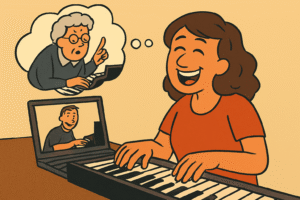 For many adults returning to the piano, the journey isn’t about picking up where they left off—it’s about rewriting the story entirely. Relearning piano as an adult isn’t a nostalgic replay of childhood lessons. It’s a reclamation. A pivot from rigid tradition to expressive freedom. From performance perfection to emotional resonance.
And here’s the truth: most adults aren’t looking to revisit the same sonatas and scales they struggled through as children. They’re not chasing trophies or recital applause. They’re chasing something deeper—connection, creativity, and the ability to sit at the piano and simply play.
Let’s explore why this shift matters, what it reveals about adult learners, and how chords and improvisation are becoming the new language of musical rediscovery.
🎯 The Adult Incentive: Not Repetition, But Reinvention
When children learn piano, the goals are often external:
- Master this piece.
- Pass this exam.
- Impress this audience.
But adults? Their goals are internal:
- Express myself.
- Relax and unwind.
- Reclaim something I lost.
This difference in motivation changes everything. Adults aren’t relearning piano to perform—they’re relearning to feel. And that’s why traditional methods often fall short.
Many adult students report that their childhood piano lessons were rigid, focused on sight-reading, technique, and repertoire memorization. Improvisation? Never mentioned. Chords? Only as part of theory drills. Creativity? Discouraged unless it fit the mold.
Now, decades later, these same students return not to repeat the past, but to rewrite it.
🎼 Why Classical Training Feels Limiting—Even If It Isn’t
Let’s be clear: classical training isn’t inherently bad. In fact, it builds:
- Finger strength and independence
- Deep understanding of harmony and structure
- Aural skills and musicality
But here’s the catch: many classical teachers never taught how to use these skills creatively. Improvisation was treated as taboo. Playing “off the page” was seen as risky or wrong.
This created a generation of pianists who could play Chopin but couldn’t jam with friends. Who could sight-read Bach but couldn’t play Happy Birthday without sheet music. Who felt paralyzed without a score.
As one adult learner put it:
“I want to play music, not just recite it.”
🎹 The Rise of Chord-Based Learning and Improvisation
Today’s adult learners are turning toward chord-based methods and improvisation for good reason:
🔸 Chords = Freedom
Learning chords unlocks the ability to:
- Play pop, jazz, blues, and gospel
- Accompany singers or other instruments
- Understand song structure and harmony
- Create music without needing sheet music
🔸 Improvisation = Expression
Improvisation invites:
- Emotional release
- Playfulness and exploration
- Personal style and voice
- Confidence in musical decision-making
And unlike classical repertoire, which demands perfection, improvisation celebrates imperfection. It’s about discovery, not delivery.
As jazz pianist and educator Diana Mascari writes:
“Improvisation isn’t about playing the ‘right’ notes—it’s about finding your voice”.
🧠 Why Adult Learners Thrive With Chords and Improv
Adult learners bring something children don’t: life experience. They’ve heard thousands of songs. They understand emotion. They know what it means to feel joy, sorrow, longing.
This makes them ideal candidates for improvisation. They’re not blank slates—they’re full of stories waiting to be told through music.
And when they learn chords, they gain the tools to tell those stories:
- Major chords for warmth and triumph
- Minor chords for melancholy and depth
- Seventh chords for tension and release
Suddenly, the piano becomes a canvas—not a test.
🧭 How to Relearn Piano As an Adult—Without Repeating Childhood Mistakes
If you’re an adult learner (or teaching one), here’s how to approach piano relearning with expressive clarity:
1. Start With Chords, Not Scales
Learn the basic triads (C major, A minor, etc.) and how they fit into songs. Use them to play familiar tunes and explore progressions.
2. Improvise Early and Often
Don’t wait until you’re “ready.” Start improvising with just two chords. Explore rhythm, dynamics, and mood. There’s no wrong way.
3. Use Lead Sheets and Fake Books
These show melody and chords—perfect for adult learners who want to play songs without full notation.
4. Record Yourself
Improvisation is about growth. Recording lets you hear your progress and refine your voice.
5. Find a Teacher Who Honors Your Goals
Not every teacher is equipped to teach improvisation. Look for someone who understands adult learners and values creative freedom.
🎁 Two Expressive Lesson Paths—No Reading Required
If you’re ready to begin, but want to skip the sheet music entirely, here are two offerings designed for expressive adult learners:
- If you’ve never played chords before, the Cocktail Piano Confidence Kit is a warm invitation. It teaches you how to sound good right away—no reading, no pressure, just expressive play.
- If you’ve dabbled with chords but want to learn how to play creatively, explore the free video series Easy Cocktail Piano. It’s playful, intuitive, and designed to help you improvise with confidence.
Both paths honor your desire to make music—not memorize it. They’re built for joy, not judgment.
🧘♀️ Emotional Benefits of Relearning Piano As an Adult
Beyond technique, relearning piano offers profound emotional rewards:
- Stress relief: Playing freely soothes the nervous system
- Creative fulfillment: Expressing yourself musically feels deeply satisfying
- Identity reclamation: Returning to piano can reconnect you with a lost part of yourself
- Confidence: Improvising builds trust in your instincts
🪞 Relearning Piano Isn’t Going Back—It’s Going Forward
To relearn piano as an adult is to reclaim a part of yourself. Not the child who practiced scales under pressure, but the adult who chooses music as a form of expression, healing, and joy.
It’s not about becoming a concert pianist. It’s about becoming a musical witness to your own life.
So if you’re returning to the piano, don’t worry about what you “should” play. Start with what you feel. Let chords be your compass. Let improvisation be your voice. And let the piano become your altar—not to perfection, but to presence.